PacketRadio.ca
Radio Infrastructure
The Difference Between Packet Radio, Broadcast Radio, and Online Radio
Packet radio, broadcast radio and online radio are different in audience, regulation and technology. Understanding the distinction is the foundation of any serious infrastructure decision.
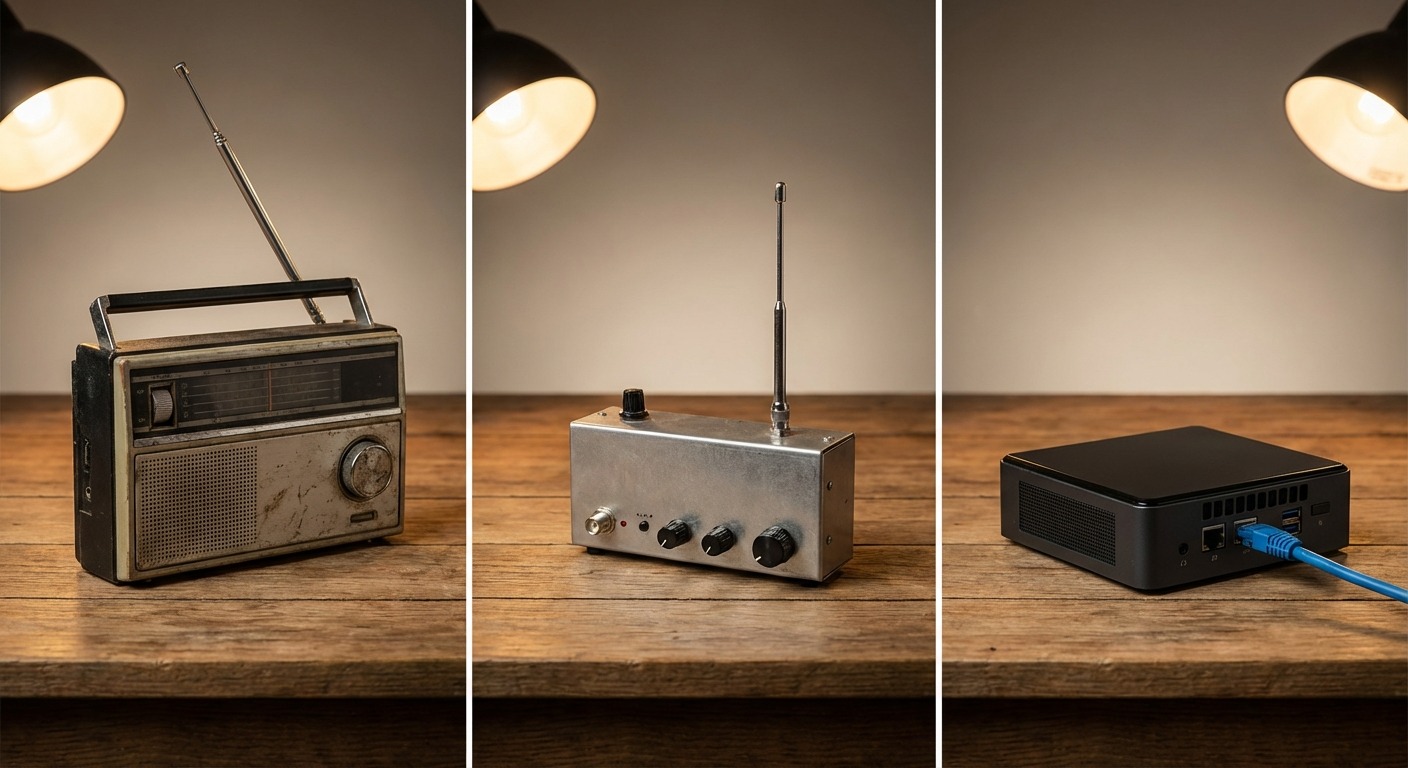
The three terms get used interchangeably in casual writing and almost never accurately. Packet radio, broadcast radio, and online radio are different in their audiences, their regulatory frames, their technical architectures, and the questions an operator has to answer before turning on the equipment. Confusing them produces bad infrastructure decisions and worse policy. This piece sorts the three out, with enough technical specificity to be useful and enough plain language to be readable by a non-engineer.
The short version: packet radio is point-to-point or point-to-many digital messaging on amateur RF; broadcast radio is one-to-many real-time audio on licensed RF spectrum; online radio is one-to-many real-time audio carried over IP networks. They share heritage. They do not share infrastructure logic.
Packet radio: addressed digital traffic on amateur spectrum
Packet radio, in the form that mattered in Southern Ontario from the mid-1980s onward, was a digital messaging system carried on amateur radio frequencies, primarily 145.01 MHz for local user access and 220 MHz for backbone links. Each transmission was a frame: a digital structure with a source address, a destination address, a payload and a checksum. Frames were not broadcast in the “everybody hear this” sense; they were addressed to a specific destination station and other receivers would simply ignore them.
The audience for any given packet message was therefore one or a few stations. The protocol layer — AX.25 at the link level, NET/ROM or AXIP at the routing level — handled the work of getting the frame from source to destination. A packet network could carry email-like messages, real-time keyboard chat, file transfers, position reports (APRS) and bulletin board content. What it could not do, and was never designed to do, was move continuous audio to a general listening audience. Our primer on what packet radio was covers the system in more historical depth.
Broadcast radio: continuous audio, licensed RF, regulated content
Broadcast radio is the form most people picture when they hear the word “radio”: AM, FM, low-power FM, the digital audio broadcast standards in countries that have adopted them, and the high-power shortwave services that still operate in some regions. The technical hallmark is a continuous modulated carrier transmitted on licensed spectrum to an unbounded audience of receivers tuned to that frequency. Anyone within the coverage contour with an appropriate receiver can listen. The transmitter does not know who, or how many, are doing so.
The regulatory hallmark is content regulation. In Canada, broadcast radio operates under licences issued by the CRTC, with technical parameters approved by ISED. The licence is granted to a specific operator, on a specific frequency, with specific power and antenna pattern, to carry a specific kind of programming under specific Canadian content rules. None of those constraints apply to packet radio, and most do not apply to online radio. The licensing reality alone makes broadcast a different operational world.
- Carrier
- The continuous RF signal that is modulated to carry audio. In FM the audio modulates the frequency of the carrier; in AM it modulates the amplitude.
- Coverage contour
- The mapped area within which a receiver of a given quality should reliably receive the signal. Determined by transmitter power, antenna pattern, terrain and frequency.
- STL (Studio-to-Transmitter Link)
- The path that carries finished audio from the studio to the transmitter site. Historically a microwave link; increasingly an IP audio path with microwave or fibre as the physical layer.
- Ingest
- In online radio, the path from the studio encoder to the streaming origin. Conceptually the online equivalent of an STL.
Online radio: audio over IP, no spectrum, different rules

Online radio is the youngest of the three and the most varied. At its core it is real-time audio encoded to a digital codec (MP3, AAC, Opus and others), packaged for streaming (HTTP-based protocols such as Icecast, HLS or DASH), and delivered to listeners over the public internet. The listener device — phone, browser, smart speaker, dedicated internet radio — pulls the stream from an origin server, often via a content delivery network that fans the signal out to many listeners without overloading any single point.
Crucially, online radio uses no broadcast spectrum at all. There is no transmitter, no antenna, no coverage contour. The “range” is whatever has internet access. The regulatory frame is correspondingly different: in Canada online-only audio services have historically not required a CRTC broadcast licence, although the regulatory landscape continues to evolve under the Online Streaming Act and subsequent CRTC consultations. Music licensing through SOCAN, Re:Sound and other rights bodies still applies, and is often where small online stations encounter their first compliance question. We walk through the practical setup in launching a small community radio station.
What the three share
Despite the differences, the three forms share more than the casual observer would guess. All three are organised around the same basic question: how do you get a signal from a source, through some kind of carrying medium, to a listener or recipient who is not in the same room? All three have to deal with capacity limits on that medium — spectrum bandwidth in the case of packet and broadcast, bandwidth and concurrency in the case of online. All three benefit from distributed architectures and suffer when overcentralised.
All three also share a volunteer-operator tradition. Packet radio was almost entirely volunteer-built. A large fraction of community broadcast radio is still operated by volunteers under the umbrella of a non-profit licensee. Online radio has a vibrant grassroots layer of small stations run by one or two people on weekends. The cultural overlap is substantial even when the technical overlap is not. Our piece on community versus online radio picks up that thread.
What the three do not share
Where the three diverge is in everything that happens after the audio leaves the source. A packet message lives or dies on the routing layer; a broadcast carrier lives or dies on the RF link budget; an online stream lives or dies on the IP transport and the streaming origin’s capacity. Failures look different. Diagnostics look different. The skills required to operate each one have only modest overlap with the others, despite all three being “radio” in casual usage.
This matters for anyone making infrastructure decisions. A small community broadcaster who treats their online stream as “just another transmitter” will mis-engineer it. A packet operator who assumes broadcast logic will mis-frame their RF planning. An online-only station that assumes broadcast-style coverage maps apply to them will misunderstand their own audience. The differences are not pedantic; they shape what works and what fails.
Where the boundaries blur
The boundaries are not perfectly crisp. Some packet protocols carry digitised voice (D-STAR, DMR, M17). Some broadcast operators stream their air signal online as a secondary distribution. Some online stations partner with broadcast licensees to put a portion of their programming on FM. Software-defined radio means the same hardware can do all three with different firmware. The categories are useful frames, not impermeable boxes.
The useful test, when the categories blur, is to ask which regulatory and technical frame the operator is actually working under. A digital voice repeater operating under amateur rules is packet-adjacent regardless of how good the audio sounds. A simulcast online stream of a CRTC-licensed FM station inherits the broadcast obligations whether or not the online portion would have them on its own. Knowing which frame applies is half the battle.
A working summary
Packet radio is addressed digital traffic on amateur spectrum, optimised for messages and routing rather than continuous audio. Broadcast radio is continuous audio on licensed spectrum to an unbounded audience, with regulated content and engineered coverage contours. Online radio is continuous audio carried over IP, with global potential reach, looser content regulation, and a streaming-server architecture that has nothing in common with an RF transmitter except the goal of making audio available to listeners.
Anyone building or writing about radio infrastructure benefits from holding the three categories distinct in their head. The shared heritage is real and worth respecting; the technical and regulatory differences are also real and ignoring them produces costly mistakes. For the older history that ties this all together, the SOPRA history is a good next stop.
One worked example is worth thinking through. Suppose a small Canadian community has the budget for either a low-power FM transmitter or a well-engineered online stream, but not both. The packet-radio reflex would be to ask which option puts the most addressable nodes in the network. The broadcast reflex would be to ask which option produces the cleanest coverage contour for a defined geographic audience. The online reflex would be to ask which option is most discoverable on the platforms that listeners already use. None of these reflexes is wrong; they are answering different questions. A community that recognises which question its actual audience cares about will make a better infrastructure choice than one that assumes the three frames are interchangeable. That recognition is the practical payoff for spending an afternoon getting the categories straight.