PacketRadio.ca
Radio Infrastructure
What Community Broadcasters Can Learn from Amateur Radio Infrastructure
Volunteer-built amateur networks solved problems that small community broadcasters still face: site coordination, redundant paths, frequency hygiene, and operating on a fraction of the commercial budget.
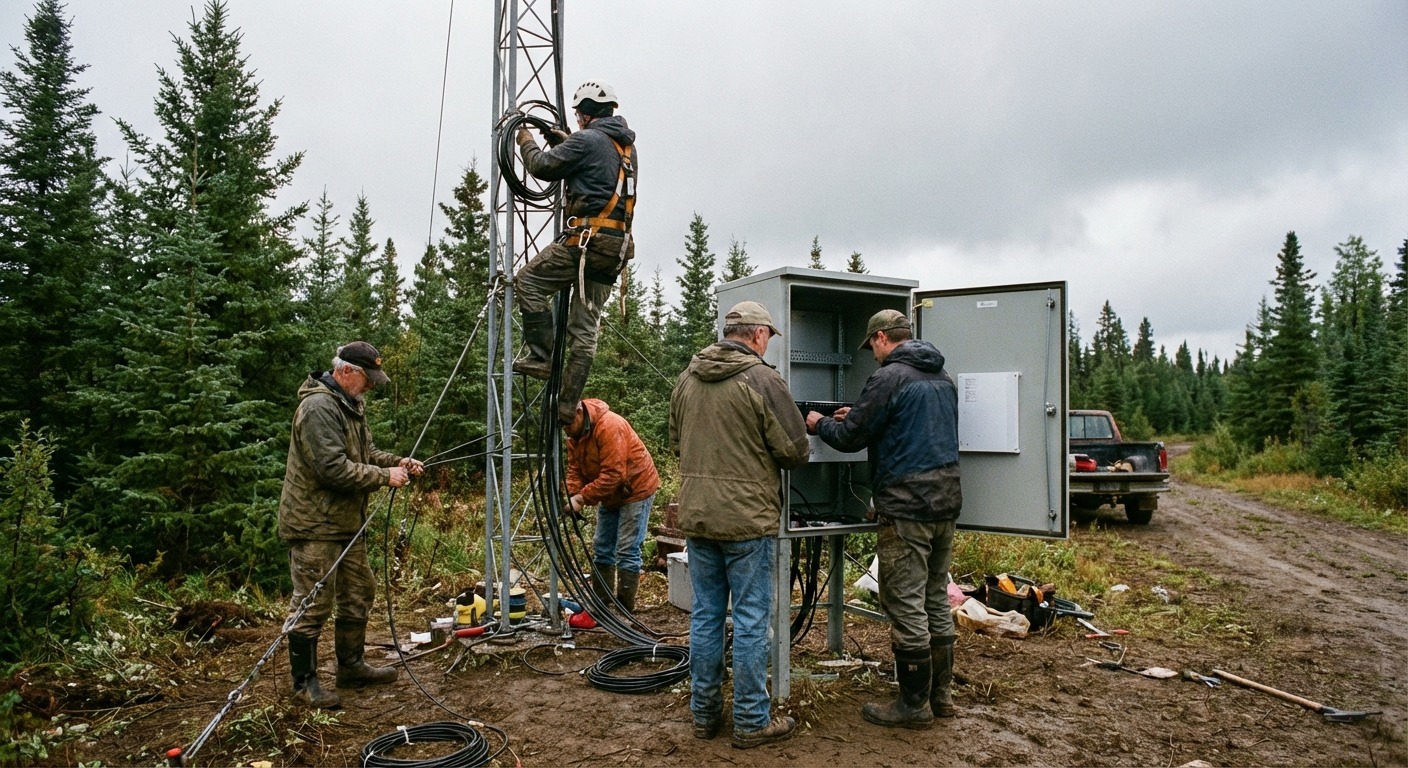
Community broadcasters and amateur radio operators usually think of themselves as different worlds. The amateurs talk about repeaters and digipeaters and net controllers; the broadcasters talk about programme directors and underwriting and CRTC filings. The two cultures rarely sit in the same room. That separation is unfortunate, because the amateur side has spent the better part of seventy years solving operational problems that small community stations now face every week, and the solutions are largely transferable.
This piece is not a romantic argument that community radio should “return to its roots” or that everyone needs a ham licence. It is a practical argument that the amateur infrastructure tradition — particularly the regional packet, repeater and EmComm networks — produced a body of operational knowledge about running distributed RF systems on a tiny budget, and that almost none of that knowledge has been written down in a form a community station manager can use. The intent here is to start that translation.
Lesson one: site coordination is a craft
Amateur networks discovered early that the bottleneck was almost never the radios. It was the sites. Getting permission to put a small antenna on a hospital roof, a water tower, a private hilltop — that was the limiting factor on coverage. The successful regional networks, including SOPRA in its working years, were built by people who treated site relationships as a long-term commitment rather than a one-time transaction. They sent thank-you cards. They turned up to sweep snow off the access path. They paid for power consumption even when the host had not asked. They did the small things that meant the host wanted them to stay.
Community broadcasters often inherit a single transmitter site from a previous era and then quietly let the relationship erode. The amateur lesson is that a second, third or fourth site is almost always available somewhere in the coverage area — a community centre roof, a co-op apartment building, a farm silo — if someone is willing to do the work of asking and then maintaining the relationship over years.
Lesson two: frequency hygiene is everyone’s job
The amateur tradition treats frequency coordination as a shared social obligation. You do not just transmit on a frequency because it is empty at the moment you happen to be listening. You consult the band plan, you check the regional coordinator’s assignments, and you accept that other operators may legitimately ask you to move if you have inadvertently caused interference. The system works because everyone in it understands they are sharing a finite resource.
Small community broadcasters operate in a more rigid regulatory environment, but the underlying ethic transfers directly. Knowing what your neighbours on the dial are doing, understanding the propagation characteristics of your own signal, paying attention to harmonic and intermodulation issues at multi-tenant sites — these are amateur disciplines first. The Radio Amateurs of Canada still publish band plans and coordination guidance that read almost like a primer on how to be a good radio neighbour.
Lesson three: build for the volunteer who replaces you
The single most useful piece of amateur engineering culture is the assumption that you will not be the person who maintains what you build. The next operator might be a teenager who joined the club last month. The next operator might be your spouse, who has never opened the equipment cabinet, trying to figure out why the repeater stopped working the day after your funeral. Good amateur infrastructure is built to be legible to a stranger.
- Labelling
- Every cable, every breaker, every coax run carries a label that explains what it does in plain language. Not a part number. A description.
- Site books
- A physical binder lives at the site. It contains the as-built drawing, the frequency plan, the contact list, the lock combinations, and a maintenance log going back as far as anyone has bothered to keep it.
- Documented failure modes
- If a particular subsystem has failed before, the failure and the fix are written down where the next operator will find them.
- Conservative engineering
- A spec margin of two or three over the worst-case load. Not because it is cheap, but because it is cheaper than a 2 a.m. callout.
Almost no commercial broadcast site we have walked through in the last decade meets all four of those standards. Almost every functioning amateur repeater site does. The difference is cultural, not financial.
Lesson four: redundancy is not luxury
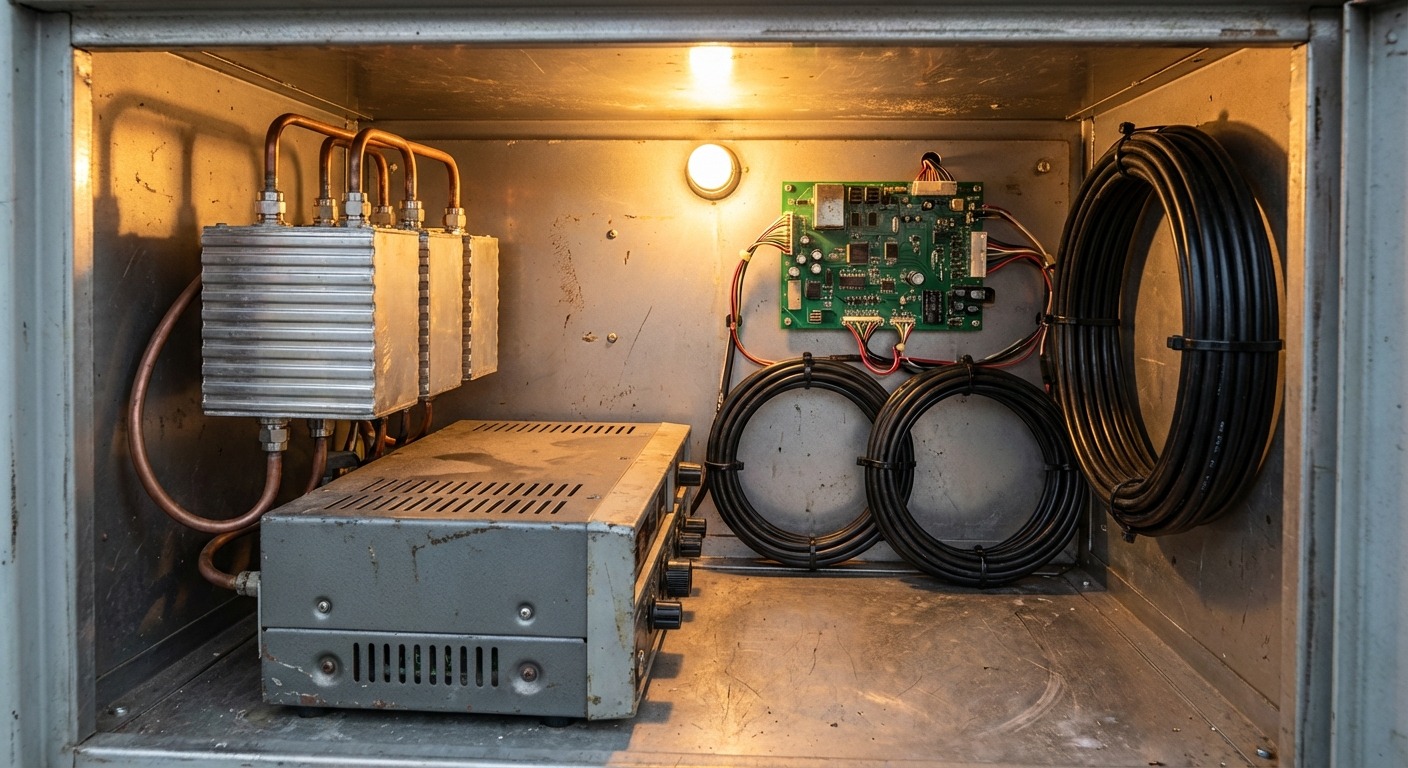
Amateur networks build redundancy because the alternative is being off the air for the only weekend per year that anyone really needed them. Community broadcasters need to think the same way. A studio-to-transmitter link that has only one path will fail. The question is not whether but when. The amateur answer — cheap secondary path, automatic failover, alarm to the duty operator — is exactly what a community FM operation should be running. We’ve written about this from a different angle in backup communications and broadcast resilience.
The cost of redundancy has fallen dramatically in the last ten years. A second STL path that would have meant a separate microwave link in 2008 can now be a small cellular modem with a static-IP business plan and a tiny power-over-Ethernet enclosure on the antenna mast. Total monthly cost: less than the dinner bill at a board meeting. Total benefit: the difference between an off-air incident lasting four minutes and one lasting six hours.
Lesson five: the network is bigger than your station
Amateur operators understand that their licence is part of a shared system. They identify themselves at intervals. They yield to emergency traffic. They cooperate during contests and field days even when it would be easier to operate in isolation. That posture — that the local operator is part of a regional network of operators — is the missing element in a lot of community broadcasting.
A community FM in one town, an online station in the next, a campus broadcaster two hours away — these are natural collaborators. They share programming traditions, equipment problems, regulatory questions, and an audience that does not particularly care which of them produced a given hour of audio. The amateur model would have them operating as a loose regional network: shared transmitter sites where it makes sense, shared programming exchanges, shared technical advice, shared volunteer pools. Some of this already happens through the National Campus and Community Radio Association and similar bodies, but there is a long way to go before the broadcast side has the same density of mutual aid that the amateur side takes for granted.
Lesson six: write everything down
If you take only one thing from the amateur tradition into a community broadcast operation, take this: write everything down, store it where the next person will find it, and update it when something changes. The packet networks of the 1990s left behind paper logs, hand-drawn maps and BBS archives that researchers can still use thirty years later. Most commercial broadcasters from the same period left almost no comparable record. The difference matters because radio infrastructure is a multi-decade enterprise. Decisions made in 2026 will affect operators in 2046 who have never met you.
A practical starting point
If a community station wanted to absorb amateur infrastructure thinking in a deliberate way, the place to start is the operations binder. Walk every site. Photograph every cable run. Draw the block diagram on paper. Write down the things everyone knows but no one has ever said out loud. Put it in a labelled binder at the site and a copy at the studio. That single exercise costs nothing and pays back the first time someone needs to fix something at three in the morning.
From there, the path is gradual. Add a redundant STL. Find a second site. Build a relationship with a local amateur club — they will almost always help in exchange for nothing more than coffee and access. The full set of habits takes years to acquire, but each individual habit is small. We pick up the broader thread in how radio communities adapt when infrastructure changes.
One closing observation. The amateur tradition is not nostalgic about its own methods. Operators who built networks in the 1980s have generally been the first to adopt SDR, IP linking and digital voice protocols when those technologies offered real improvements. What they kept was not the specific equipment but the discipline of operating it: the documentation, the labelling, the willingness to be the volunteer who climbs the tower in November. That discipline is genuinely portable to any small broadcast operation that wants it. The barrier is not technical; it is the decision to take infrastructure seriously as a craft rather than as overhead. Stations that make that decision tend to outlast the ones that do not, by margins large enough to be visible across a single decade.