PacketRadio.ca
Online Radio
Building a Low-Cost Online Radio Stack
A grounded, line-by-line view of building a low-cost online radio stack for a small Canadian community station: hosting, software, licensing, monthly costs and the boring documentation that keeps it running.
The most useful framing for a small-station budget is not "what does it cost to launch" but "what does it cost to still be running in three years." Launches are cheap; the equipment lasts, the volunteers are excited, the hosting is on a free trial. Three years in, the trials have ended, the original technical lead has moved away, the volunteer roster has turned over twice, and the question is whether the station can be operated on the budget the board can actually find every quarter. A stack that is genuinely low-cost is one that survives that test.
This piece walks through the components of such a stack with realistic 2026 Canadian numbers attached. It is meant to be read alongside our overviews on launching a small community station and streaming infrastructure for independent local radio, both of which cover the same ground from different angles.
The fixed monthly bill
Every small station has three categories of fixed monthly cost: hosting, music licensing, and incidentals. Most of the published advice underestimates the third category and is either too vague or too aspirational about the first two. Realistic ranges for a town-scale Canadian station with a few hundred unique listeners a week look roughly like this.
- Streaming server / VPS
- $10–25 CAD/month for a single small VPS sized for <100 simultaneous listeners. Bandwidth-inclusive plans avoid surprise overage charges.
- Backup or secondary server
- $5–15 CAD/month at a second provider, kept warm. Optional in year one, sensible from year two onward.
- Domain and DNS
- $20–30 CAD/year, amortised. A managed DNS provider with health-check failover may add $5/month and is worth it for stations that take outages seriously.
- SOCAN tariff
- Calculated against gross revenue or a small minimum, depending on the applicable tariff and the station's status. Read the current tariff sheet at socan.com rather than relying on second-hand summaries.
- Re:Sound tariff
- The performers' and labels' counterpart to SOCAN. Also calculated against revenue or against a minimum, with details at resound.ca.
- Incidentals
- SSL certificates if not free, occasional plugin licences, payment processor fees on donations, the annual replacement of a broken cable. Budget $10–20 CAD/month as a rolling reserve.
For a non-commercial station playing music, the realistic combined monthly cost in 2026 sits in the $15–80 CAD range depending on how much music it plays and how seriously it takes redundancy. A spoken-word-only station that does not need extensive music licensing can come in well under that. A station with a more ambitious schedule, multiple bitrates and a CDN can spend more, but the core message is that this is one of the few civic projects available to a small town that costs less per month than a single restaurant meal for the board.
The software stack
The conventional open-source stack is unchanged from the analysis in our infrastructure piece: Icecast at the distribution layer, Liquidsoap at the encoder/automation layer, and either a hand-written setup or AzuraCast as the management wrapper. The licensing on all three is permissive enough that a community station does not need to pay for any of them. The cost is in the time to set them up and the discipline to keep them documented.
A reasonable minimal install looks like this on a single small Linux VPS:
# conceptual install order on a small Debian/Ubuntu VPS
apt update && apt install -y icecast2 liquidsoap certbot
# configure /etc/icecast2/icecast.xml with mount points and admin password
# write /etc/liquidsoap/station.liq with sources, fallbacks and output
# enable both as systemd services and verify they survive a reboot
# obtain TLS certificate and reverse-proxy through nginx for HTTPS streaming
None of those steps are difficult in isolation. The trap is that they are tedious if you have not done them before, and the small mistakes (wrong passwords in the wrong place, mount points that do not match between Liquidsoap and Icecast, a TLS certificate that expires in 90 days and is silently not renewed) accumulate. AzuraCast hides most of this work, at the cost of one more layer to learn when something goes wrong.
Hardware: less than you think
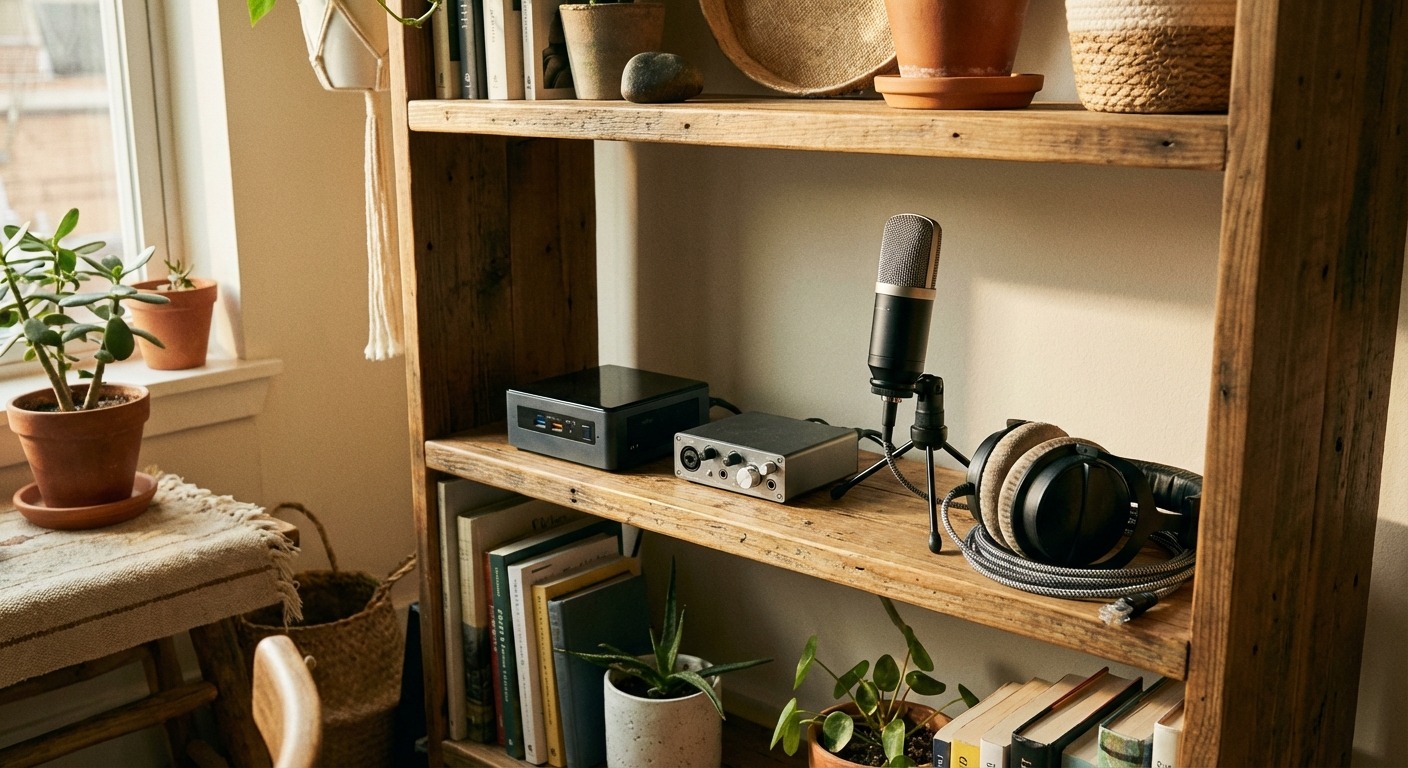
A capable single-host setup needs a USB or XLR condenser microphone, a small audio interface or basic mixer, a pair of closed-back headphones, and a laptop or desktop computer that is not also being used for anything else important. Realistic 2026 Canadian prices for entry-level broadcast-acceptable gear sit around $150–250 for the microphone, $150–300 for the interface or mixer, $80–150 for the headphones, and whatever the studio computer costs. A complete entry-level studio can be assembled for around $700–1,200 if the computer already exists.
Spending more on the room than on the equipment is almost always the right call. A bookshelf along one wall, a heavy curtain over the window, a closed door, a chair that does not squeak, and a small piece of acoustic foam behind the microphone do more for the perceived quality of the broadcast than a five-hundred-dollar upgrade to the microphone would. We touched on the same trade-off in our piece on community versus online radio; the operational instincts transfer.

The boring documentation that keeps it running
The single largest cause of small stations going off the air for embarrassing periods is not technical failure. It is missing documentation. The original installer set everything up in a long weekend, never wrote any of it down, and is now unreachable. Two years later, an SSL certificate expires, the stream goes silent, and nobody on the current roster knows where the renewal command lives or which server it needs to be run on.
The fix is unglamorous and effective. Write a short operations manual in a shared document, kept current, that lists: the hosting providers used and which board member holds which account, the admin URLs for every system, the location of every credential (in a password manager that more than one person can access), the renewal dates for domains and certificates, the SOCAN and Re:Sound contact information, the rough monthly cost of each line item, and a one-page recovery procedure for the three most likely failure modes (server reboot loop, DNS pointing at a dead host, source connection refused). Update it whenever something changes. Review it once a quarter at a board meeting.
This is the same operational discipline that kept SOPRA's packet network alive across volunteer turnover in the 1990s, and it is the part of the work that no software can do for you. We treat it more broadly in lessons from amateur infrastructure.
Where the cost actually grows
If a station does grow — more shows, more listeners, more ambition — the cost increases tend to come in predictable places. Bandwidth is the first: a popular sports broadcast can spike concurrent listeners well above the design point, and a VPS plan that was comfortable at 20 listeners can be expensive at 200. A CDN in front of the Icecast origin smooths this out and is often cheaper than a bigger origin server.
Music licensing scales with revenue rather than listeners, so a station that takes on advertising or sponsorship revenue should re-read the SOCAN and Re:Sound tariffs before committing to anything. The tariffs are graduated, and the rates that apply to a non-commercial small streamer are not the rates that apply once revenue crosses certain thresholds. Surprises here are avoidable and entirely the operator's responsibility.
The third area of growth cost is human. Volunteer-only stations have a real ceiling, and the move from "all volunteer" to "one paid coordinator at part-time hours" is the largest single budget step a small station ever takes. It is also, for many stations, the difference between a project that quietly fades and one that becomes part of the town's permanent infrastructure.
A worked example budget
To make this concrete, consider a hypothetical small Eastern Ontario town with a non-commercial online station running mixed music and local programming, around 30 average concurrent listeners with peaks of 80, no paid staff, a single physical studio in a donated room. A realistic monthly budget might look like this.
- Primary VPS (Canadian provider, 2 vCPU, 4 GB RAM, 4 TB transfer)
- $20 CAD
- Secondary VPS at a second provider, warm standby
- $10 CAD
- Managed DNS with failover
- $5 CAD
- Domain renewal (amortised)
- $2 CAD
- SOCAN minimum tariff (amortised)
- $15–25 CAD
- Re:Sound minimum tariff (amortised)
- $10–20 CAD
- Incidentals reserve
- $10 CAD
- Total
- roughly $70–90 CAD/month
That is well within the range a service club, a library board or a small municipal grant can sustain indefinitely. Once the station is running, the marginal cost of adding more shows is essentially zero; once the documentation is written, the cost of surviving a volunteer turnover is essentially zero. Almost all of the project's value compounds against fixed costs that do not.
The point of doing it cheaply
The reason to keep a community stack inexpensive is not penny-pinching. It is sustainability. A station that costs $80 a month to run can be kept on the air through a difficult year, a board reorganisation, a change of coordinator. A station that costs $800 a month cannot. The same logic that drove SOPRA's packet network operators to build cheap, replaceable nodes in the 1990s — the topic of our history of the Southern Ontario Packet Radio Association — applies to community streaming today. Cheap, well-documented and dull is the architecture that survives. For the broader case behind that posture, see why distributed networks still matter, and for examples of how the philosophy plays out in real Canadian projects, our tour of independent community audio across the country.